
CiteMap: Agency AI Citation-Gap Intelligence
A hackathon prototype that maps where brands are missing from AI answers, who shows up instead, and which sources agencies should act on next.
 OpenAI Codex
  Claude Code
CiteMap is the tool I built for the Profound Marketing Engineering Hackathon: a one-day, solo-builder event where the challenge was to find a marketing process that is inhuman in scope or scale and ship a system or agent that runs it.
My target was agency AI visibility work.
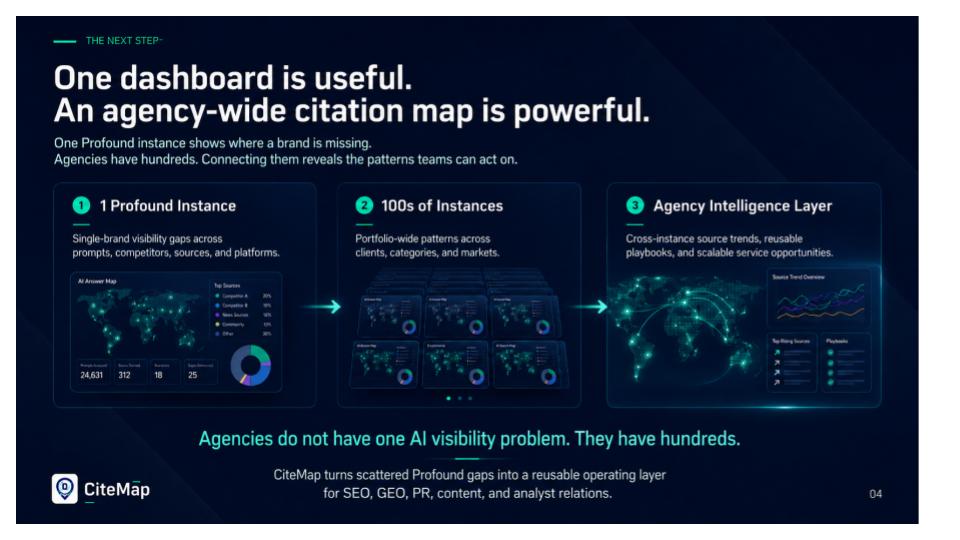
One Profound dashboard can show where a single brand is missing from AI answers. That is useful. But agencies do not have one AI visibility problem. They have hundreds of them across clients, categories, competitors, markets, prompts, and platforms.
CiteMap turns scattered answer data into an agency-wide citation map: where a brand is absent, who replaces it, which sources support the answer, and what an SEO, GEO, PR, content, or analyst-relations team should do next.
The problem
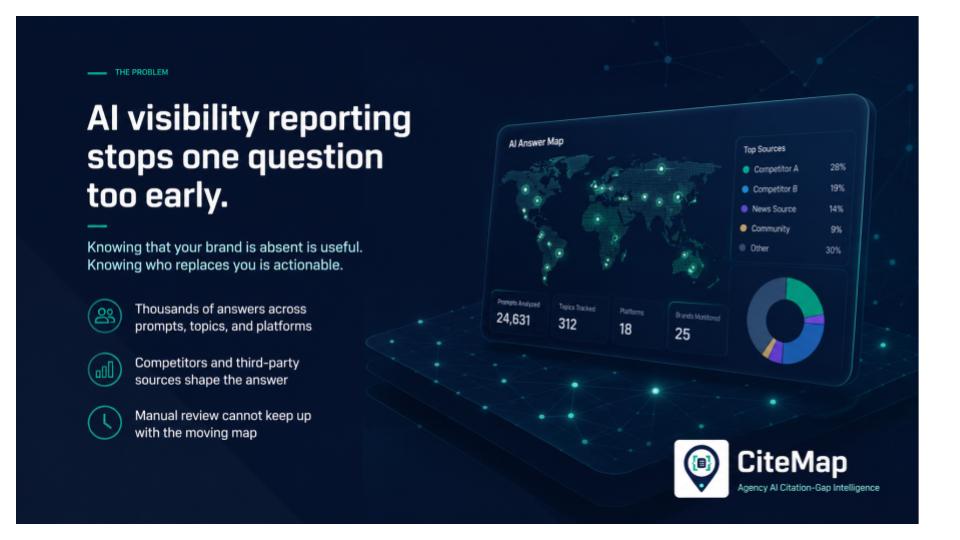
AI visibility reporting often stops one question too early.
Knowing that your brand is absent is useful. Knowing who replaces you is actionable.
As AI search and answer engines become part of how people discover products, the old visibility question gets more complicated. A company might be missing from an answer while competitors, review sites, analyst reports, category pages, publishers, or community threads are doing the shaping.
That creates a pile of questions no human wants to answer by hand:
- Where is the brand missing from AI answers?
- Who appears when the brand does not?
- Which third-party sources are repeatedly shaping those answers?
- Are the gaps concentrated by topic, platform, competitor, or citation domain?
- What should the marketing team actually do next?
What CiteMap does
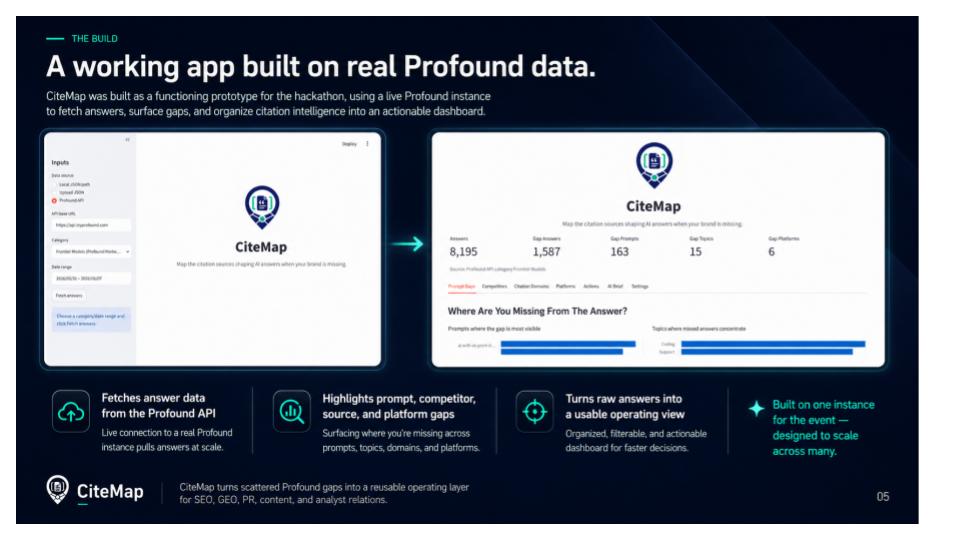
CiteMap analyzes Profound raw answer data and identifies citation gaps where a target brand is absent while competitors, category authorities, or influential citation sources appear.
The working prototype supports:
- Loading Profound raw answer exports from a local JSON path
- Uploading Profound JSON files directly in the app
- Fetching answers from the Profound API when an API key is configured
- Configuring target brand terms and competitor terms in the sidebar
- Detecting prompt-level citation gaps
- Comparing competitor and category-term appearances
- Extracting citation URLs and citation domains from answers
- Showing platform-level gap severity and mention-frequency views
- Enriching cited domains with available external and internal data sources
- Mapping source roles into action lanes
- Exporting key tables as CSV files
- Generating AI Briefs from compact aggregated tables
In plain English: it helps a team stop staring at raw answer logs and start seeing the operating plan.
How it works
CiteMap starts with AI-answer data from Profound. The user defines the target brand and optional competitor terms. The app scans each answer for target mentions, competitor or category mentions, and citation URLs.
A citation gap is:
target absent + competitor/category term present + citation URL presentFrom there, CiteMap groups the data into practical views:
- Prompt gaps: which prompts create missed visibility opportunities
- Competitor analysis: which competitors appear when the target brand does not
- Citation analysis: which URLs and domains repeatedly support answers without the brand
- Platform views: where gaps are concentrated across answer platforms
- Action lanes: how different source types become SEO, GEO, PR, content, or analyst-relations work
Why the agency layer matters
A single-brand AI visibility dashboard is helpful, but it is not the whole agency workflow.
Agencies need to spot patterns across clients:
- Are the same publishers shaping multiple categories?
- Are certain competitors showing up in answer gaps again and again?
- Which source types create the fastest action path: owned content, digital PR, review sites, analyst pages, or partner ecosystems?
- Which findings are reusable across clients instead of being trapped inside one-off reports?
That is where CiteMap gets interesting. The prototype was built on one Profound instance for the event, but the direction is an agency intelligence layer that can scale across many.
Built with
- UI: Streamlit
- Language: Python
- Data work: pandas
- Source data: Profound raw answer exports and API data
- Domain enrichment: external enrichment APIs, internal reference data, and shared data-lake context
- AI brief generation: compact summaries from aggregated citation-gap tables
- Build partners: OpenAI Codex and Claude Code
The stack was intentionally lightweight. This was a hackathon build, so the goal was not to create a heavy production SaaS or lock the workflow to one enrichment vendor. The goal was to prove the intelligence workflow: ingest the data, detect the gaps, enrich it with whatever reliable context the team has access to, organize the sources, and turn the results into something a team can act on.
What I shipped at the hackathon
By the demo deadline, CiteMap could ingest Profound answer data, detect citation gaps, summarize competitor and citation patterns, enrich domains with connected context, and generate compact AI-powered briefs.
That gave the judges a working app, not just a deck with a nice map and some emotionally supportive arrows.
The more important proof was the workflow: AI visibility work becomes much more useful when it moves from “did we show up?” to “when we did not show up, who shaped the answer, and what do we do about it?”
What is next
CiteMap is still a prototype. The next version would need stronger entity matching, richer source classification, sanitized demo data, exportable reports, better multi-client workflows, and cleaner tracking over time.
The product direction is clear, though:
- agency-wide citation intelligence
- reusable source and competitor patterns
- better action routing for GEO, SEO, PR, content, and analyst relations
- trend tracking over time
- reports that feel like decisions, not spreadsheets wearing a tie
CiteMap is a working hackathon prototype. The public story is the workflow and product idea, not the private answer data behind the demo.
Sources
- Profound Marketing Engineering Hackathon — June 6, 2026 event at Profound HQ in New York City.