· Matt Ballek · 15 min read
The 7 Best Claude Design Alternatives in 2026
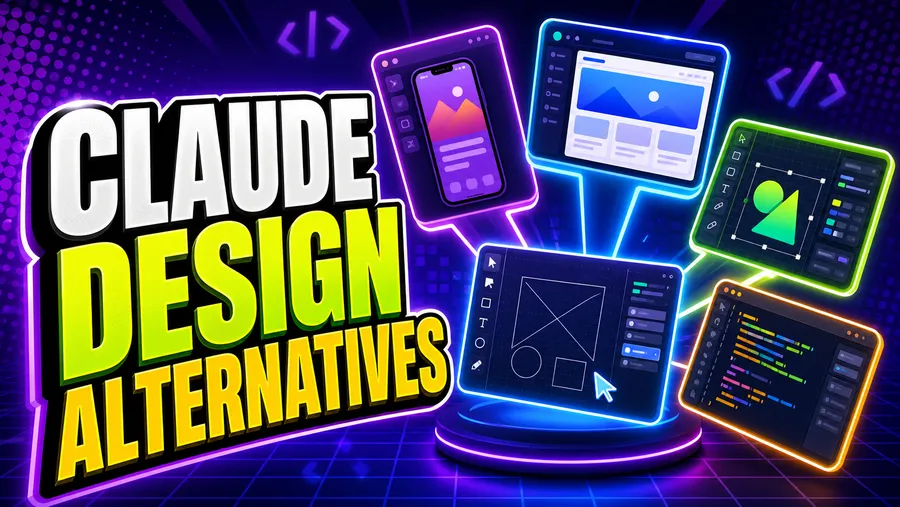
Claude Design is impressive, but it shares usage limits with the rest of Claude. These alternatives are better fits for free UI exploration, Figma workflows, production code, full apps, and presentations.
I started looking for Claude Design alternatives after hearing the same warning more than once: it is great until it eats through your Claude usage.
I also remembered that Google had launched something called Skitch. Or Stitch. Or maybe Skitch was the app I used to draw arrows on screenshots in 2013.
It is Google Stitch.
And yes, Stitch is one of the strongest alternatives to Claude Design. It is probably the first one I would try if your main goal is designing app screens without borrowing from the same pool you use for Claude chat and Claude Code.
It is not the automatic winner for everyone, though. Claude Design covers a strangely large territory: interface mockups, interactive prototypes, presentations, one-pagers, social assets, and code-powered experiments. No alternative replaces all of that equally well.
The better question is: What are you trying to have in your hands when the design session ends?
The quick answer
| Tool | Best for | What you get | Main catch |
|---|---|---|---|
| Google Stitch | Exploring web and mobile UI | High-fidelity screens, prototypes, and design rules | Still an experimental Google Labs product |
| Figma Make | Teams already using Figma | Functional prototypes inside the Figma workflow | AI credits can also disappear faster than expected |
| v0 | Frontend code you plan to ship | Working UI and full-stack web app code | Strongest when your stack looks like Vercel’s preferred stack |
| Lovable | Turning an idea into a working app | UI, code, hosting, database, and integrations | Credits and hidden architecture choices need attention |
| Magic Patterns | Product teams with a React design system | Collaborative prototypes using real components | More product-UI focused than Claude Design’s broad canvas |
| Canva | Marketing graphics and everyday visual work | Editable social posts, one-pagers, decks, and simple sites | Not the place to design a serious product flow |
| Gamma | Presentations and visual documents | Polished decks, docs, and lightweight web pages | It is not an app-interface design tool |
My quick pick: Start with Google Stitch for UI exploration, v0 when you want code, and Lovable when you want the whole app to start working.
If you mainly wanted Claude Design for decks and marketing assets, skip the app builders and go directly to Gamma or Canva.
Why people are looking beyond Claude Design
Claude Design is an Anthropic beta that puts a conversation beside a visual canvas. You describe what you need, Claude creates it, and then you refine it through chat, comments, or direct edits.
The impressive part is the range. Anthropic positions it for prototypes, wireframes, design explorations, pitch decks, marketing collateral, and documents. It can import a design system and hand finished work to Claude Code or tools including Canva, Gamma, Lovable, Replit, Vercel, and Wix.
That is a lot of creative machinery attached to one chat box.
The usage model is also the source of the complaint. Anthropic says Claude Design activity counts toward the same plan limits as Claude chat, Claude Code, and Cowork. There is no separate little snack drawer labeled “design tokens.” It is all coming out of the same kitchen.
If you use Claude for writing, research, and coding all day, spending that shared allowance generating twelve homepage directions can feel expensive even when Claude Design itself is included with your plan.
That does not make Claude Design a bad deal. It means heavy design iteration can compete with the rest of your Claude workflow.
One warning before we rank the replacements: most AI design tools meter something. Figma uses AI credits. Lovable uses credits. Magic Patterns uses credits. v0 has plan limits and credits. Switching tools may give you a separate allowance or a more suitable workflow, but it does not summon free computers from the sky.
1. Google Stitch: the best place to start
Google Stitch is the closest answer to “What was that Google thing called?”
Google describes Stitch as an AI-native design canvas for turning natural language into high-fidelity interfaces. You can bring in text, images, and code as context, explore multiple directions on an infinite canvas, and use a design agent to help refine the project.
The most interesting part for vibe coders is DESIGN.md. Stitch can turn design rules into a portable markdown file that other design and coding tools can read. That gives you a way to settle colors, type, spacing, and component direction before asking a coding agent to build the real thing.
I would use Stitch when:
- I want to explore several web or mobile interface directions quickly.
- I need a visual prototype before I commit to code.
- I want to hand a clearer design system to Codex, Claude Code, or another builder.
- I do not want every design experiment drawing from my Claude allowance.
I would be careful when:
- The project needs a mature team workflow today.
- I need the design tool to be the permanent source of truth.
- I am depending on a Google Labs experiment to behave exactly the same six months from now.
Google is moving Stitch toward a broader collaborative product, but it still carries the word “experimental.” I would happily use it to find a direction. I would keep the important design rules and final code somewhere I control.
Best for: Free-form UI exploration and a clean design-to-coding handoff.
2. Figma Make: best if your work already lives in Figma
Figma Make adds prompt-based generation to the design environment many product teams already use.
It can generate a functional prototype or web app, accept existing Figma designs and components as context, publish a prototype, connect to Supabase, and turn the preview back into editable Figma design layers.
If a designer needs to keep editing the result as a real design instead of treating AI output like a mysterious sealed sandwich, Figma has an obvious advantage.
I would use Figma Make when:
- My team already uses Figma files, libraries, comments, and handoff.
- I want AI output to stay near the existing design system.
- Designers and developers both need to work on the result.
- The prototype needs to become editable design layers.
I would be careful when:
- My main reason for leaving Claude Design is unpredictable AI consumption.
- I do not already like working in Figma.
- I want a simple prompt-to-production-code path.
Figma Make is not an escape from metering. Figma says Make usage varies with the model, task complexity, and amount of context. Its free Starter plan includes a limited monthly allowance, and paid full seats include more AI credits. A complicated generation can cost more than a tiny edit.
The real reason to choose Figma Make is not cheaper tokens. It is fewer awkward handoffs when your product already speaks Figma.
Best for: Product teams already living in Figma.
3. v0: best when the destination is frontend code
v0 is Vercel’s prompt-to-app tool. It can create interface components, pages, and full-stack web apps, then let you edit the code, sync through Git, and deploy to Vercel.
Claude Design is happy to help you explore what a thing should look like. v0 becomes more attractive when you already know the thing should become a React or Next.js application.
It also accepts screenshots, mockups, and Figma designs. That creates a useful workflow: explore the direction visually, then ask v0 to turn the chosen version into working UI.
I would use v0 when:
- I want a real component or web page, not only a mockup.
- I am building with React, Next.js, Tailwind, or shadcn/ui.
- I want to export the code and keep working in my own repo.
- One-click Vercel deployment is a feature, not a trapdoor.
I would be careful when:
- The team needs deep free-form visual editing before coding.
- My app uses a very different frontend stack.
- I am letting generated code skip review because the preview looks nice.
Vercel says v0 can build full-stack apps, including database connections, authentication, API calls, and backend logic. That makes it more than a design substitute. It also means it can create more app than you intended.
Keep the first request narrow. A good homepage component is easier to inspect than an entire startup that appeared while you were reheating lunch.
Best for: High-quality UI that should leave the design tool as working code.
4. Lovable: best when you want the whole app to work
Lovable is the strongest option here for a beginner who needs to see the idea become a working application.
It can generate the interface and continue into the database, authentication, APIs, integrations, hosting, and deployment. You can connect GitHub and keep the generated code.
This is a different promise from Claude Design. You are not just making the proposed checkout screen. You can make a checkout screen that is attached to an app.
I would use Lovable when:
- Seeing a working first version will help me make better product decisions.
- I want UI, backend, and hosting in one beginner-friendly workflow.
- I plan to connect common services such as Supabase or Stripe.
- I want to publish a test version without assembling every tool myself.
I would be careful when:
- I only need visual exploration.
- I am not reviewing the database, login, or security decisions it makes.
- I expect leaving one token system to mean leaving credit systems entirely.
Lovable now varies credit use by task complexity. A small style change can cost less than building a landing page, and paid workspaces use one balance across building and running apps. That is more understandable than pretending every prompt performs the same amount of work, but it still rewards clear, contained requests.
Lovable is the pick when “design the app” really means “please make enough of the app that I can click around and judge the idea.”
Best for: Beginners moving from prompt to working web app.
5. Magic Patterns: best for product teams and real React components
Magic Patterns is focused more tightly on product UI than Claude Design.
It creates interactive prototypes, supports shared workspaces, connects to design systems, syncs with GitHub, and offers an MCP path for handing design context to engineering tools. The useful distinction is that a team can generate with its real React components instead of producing a beautiful stranger that somebody has to translate later.
I would use Magic Patterns when:
- I am designing a multi-screen product flow with a team.
- We already have a React component library or design system.
- Product, design, and engineering all need to comment on the same prototype.
- Engineering handoff matters more than making decks or social images.
I would be careful when:
- I am a solo beginner who only needs one quick landing page.
- I need the broad presentation and marketing-asset range of Claude Design.
- I am expecting unlimited AI generation.
Magic Patterns uses complexity-based credits, although manual visual edits, exports, sharing, and its “Fix with AI” action do not consume them. Paid plans can also enable on-demand usage with budget controls.
That makes it a credible alternative for a team trying to control the whole prototype-to-code loop. It may be more machinery than a solo idea needs.
Best for: Collaborative product design connected to a real React system.
6. Canva: best for marketing graphics and everyday design
Canva is the obvious alternative if the part of Claude Design you care about is social posts, one-pagers, simple presentations, or other marketing collateral.
Canva gives you templates, brand kits, direct visual editing, stock assets, and AI assistance in a tool that normal humans have already seen. You do not need to explain to a teammate why the design is technically a code-powered artifact living inside an AI conversation. You send them the Canva link. They move the headline two pixels and feel alive.
I would use Canva when:
- I need a social graphic, flyer, one-pager, or simple deck.
- A non-designer needs to edit the result later.
- Brand templates and reusable asset sizes matter.
- I want predictable manual control after AI makes the first draft.
I would be careful when:
- I am designing an authenticated product or multi-screen app flow.
- I need production-ready frontend code.
- The work depends on real application components.
Canva is not the closest Claude Design alternative for product UI. It may be the most sensible replacement for half the things Claude Design can make.
Best for: Marketing assets people need to keep editing and reusing.
7. Gamma: best for presentations and visual documents
Gamma is the specialist pick for decks, reports, proposals, and visual documents.
You give it an outline or prompt, and it handles much of the layout and typography. The output is responsive, editable, and shareable as a presentation or lightweight web page.
I would use Gamma when:
- The final deliverable is a pitch deck, report, lesson, or proposal.
- I care more about a clear story than detailed interface design.
- I want to get from rough outline to presentable structure quickly.
- The result needs to be shared on the web.
I would be careful when:
- The word “design” actually means product UI.
- I need frontend components or a full application.
- I expect AI generation to be unmetered.
Gamma also uses AI credits, with consumption varying by model and generation size. Again, the win is not escaping all limits. The win is using a tool whose entire workspace is shaped around the thing you are making.
Best for: Turning an outline into a polished presentation or visual document.
What about Flowstep?
Flowstep deserves an honorable mention, especially if predictable usage is the entire reason you are shopping.
It generates multi-screen product UI, lets you paste editable layers into Figma, exports React, TypeScript, and Tailwind code, and can connect to coding agents through MCP. Its paid Starter plan currently includes 80 messages for $15 per month. One prompt equals one message regardless of complexity, and a failed generation does not count.
That is easier to estimate than a mystery scoop of tokens. It is still a limit: follow-up prompts count as messages, and the allowance resets monthly.
The Claude Design alternatives guide ranking Flowstep number one is published by Flowstep. That does not make the comparison useless, but the home team did write the scoreboard. I would want to test the Figma layers and exported code on a real project before calling it the overall winner.
If your main workflow is prompt → editable Figma design → React code, Flowstep belongs on your three-tool trial.
Which Claude Design alternative should you choose?
Use this decision tree:
- Do you want to explore app or website UI? Start with Google Stitch.
- Does your team already live in Figma? Use Figma Make.
- Do you want frontend code you can ship? Try v0.
- Do you want the whole app to start working? Try Lovable.
- Do you have a real React design system and a product team? Shortlist Magic Patterns.
- Are you making graphics or reusable marketing assets? Use Canva.
- Are you making a deck or visual document? Use Gamma.
This is why a single “best alternative” ranking gets weird. Google Stitch and Gamma can both replace part of Claude Design, but asking them to trade jobs would be like asking a wrench and a toaster to settle things in the parking lot.
How to compare them without burning every free credit
Do not test seven tools with seven different ideas. Give the strongest three the same small assignment.
For UI tools, try:
Design a responsive dashboard for a solo creator who tracks content ideas.

Include:
- a left navigation with Ideas, Drafts, Published, and Settings
- a top row with three simple performance metrics
- a sortable table of content ideas
- one clear button to add a new idea
- desktop and mobile versions

Visual direction:
- friendly and playful, not corporate
- deep purple, bright green, and warm yellow accents
- large readable type
- avoid glassmorphism and generic gradient cards

First, create one strong direction. Do not build a backend or add extra pages.
Then compare:
- Did it follow the actual request?
- Does the interface feel specific or like AI dashboard number 4,000?
- Can you correct one part without regenerating everything?
- Can you export the format you need?
- Can another person edit it?
- How much usage did one useful direction consume?
The last question matters more than the advertised number of credits. A tool that needs two prompts can be cheaper than one with a giant allowance that needs eleven apologies.
My recommendation
If shared Claude usage is the reason you are looking around, I would start with Google Stitch.
It is the cleanest separate playground for exploring interface directions, and its DESIGN.md approach fits nicely with a vibe-coding workflow. Find the visual rules in Stitch, then bring those rules into the coding tool where your actual project lives.
I would pick v0 instead when I already know I want a working React or Next.js interface. I would pick Lovable when the real goal is a working app and I want the shortest beginner-friendly path from description to deployed test.
For an established product team, the boring answer may be the right one: Figma Make if Figma is already the center of the design process, or Magic Patterns if React components and engineering handoff are the bigger priority.
And if you only need a pitch deck, please do not accidentally build a full-stack application. Open Gamma. Make the slides. Go outside.
Frequently asked questions
What is the best free Claude Design alternative?
Google Stitch is the first option I would check for app and website UI exploration without buying another dedicated design subscription. Access and limits for experimental Google products can change. Figma Make, v0, Lovable, and Magic Patterns also offer limited free ways to start, but their allowances and AI credit systems can change.
Is Google Skitch a Claude Design alternative?
The product is called Google Stitch. Skitch is a different screenshot-annotation app. Google Stitch creates and iterates on web and mobile interface designs with AI.
Does Claude Design use Claude tokens?
Anthropic describes the limit as shared usage rather than a separate Claude Design allowance. Claude Design activity counts toward the same plan limits used by Claude chat, Claude Code, and Cowork.
Is Figma Make better than Claude Design?
Figma Make is a better fit when your designs, components, collaborators, and developer handoff already live in Figma. Claude Design is broader and connects naturally to Claude Code. Both meter AI activity, so the choice should be based on workflow rather than an assumption that Figma usage is unlimited.
Is v0 a design tool or an app builder?
It is both, but it leans toward building. v0 can generate high-fidelity UI from prompts or images and continue into working frontend or full-stack code. Choose it when code is the desired output.
Can I use Claude Design without burning through my Claude limit?
You can reduce waste by asking for one direction at a time, making targeted edits, reusing a design system, and moving simple manual adjustments to the canvas. But Claude Design still counts against your shared Claude plan usage.
Sources and further reading
- Claude Design product overview
- Anthropic’s Claude Design getting-started guide
- Google’s introduction to the new Stitch canvas
- Figma AI credit documentation
- v0 full-stack app documentation
- Lovable pricing and credit explanation
- Magic Patterns credit and plan documentation
- Flowstep pricing and message limits
- My full Lovable review